You can bet on anything these days. But betting isn't investing.

Own your future. Don't bet on it. 

Investing is ownership. Gambling isn't.

When you invest, you're acquiring a stake in real businesses and their future cash flows. You're participating, over time, in the compounding engine of economic growth.

That long-term participation is what often gives investing its power. History shows that patient investors who stay disciplined through volatility are typically rewarded not for predicting the future, but for remaining invested in it.

At Schwab, this idea isn't new. It's the foundation of how we think about investing, how we teach it, and how we help clients pursue their financial goals.

Hi, everyone. I'm Liz Ann Sonders, and this is the April Market Snapshot. Thank you, as always, for tuning in.

This month's episode is a little more big picture, and on a topic that will likely remain evergreen, but it does have a tie-in to the current crazy market environment. In fact, I published a report on the subject this week as well, but I wanted a video version of it, so here we go.

There is a concept that has long anchored the philosophy of long-term wealth creation, which is owning. When you invest, you are generally acquiring a claim on future cash flows and on productive assets, on the compounding engine of capitalism itself. You are not wagering on an outcome and walking away with either a windfall or nothing. You are a participant in the ongoing enterprise of wealth creation, and that distinction matters more than it may seem at first glance, especially in today's environment.

Now, gambling operates on an entirely different logic. The gambler hopes. The investor owns. Both involve uncertain outcomes and both require accepting the possibility of loss, but the underlying architecture of each is fundamentally different. A diversified portfolio held through cycles and volatility historically has rewarded patience and discipline with real compounding returns. Although of course, past performance is no guarantee of future results. The house in casino gambling, a sports book or a prediction market is structured to help ensure that in the aggregate it wins and the participants in the aggregate do not.

This distinction has never been more important to articulate clearly. The youngest generation of investors is being inundated with the message that investing and gambling are essentially the same thing. The platforms and often the personalities delivering that message have worked hard to make the experience look and feel like a casino—emphasizing entertainment, instant gratification, the thrill of placing a bet on nearly anything these days.

[High/low charts for "Betting goes bonkers" for Prediction market monthly notional volume, number of transactions and number of users is displayed]

Prediction markets specifically have grown exponentially, as shown here. It's not just monthly volume growth, which has risen to more than $25 billion since 2024, and that's according to Dune. It's also total transactions which have skyrocketed from about 240,000 to more than 200 million, while monthly active users have grown from about 4,000 to almost 900,000. At the same time, a March 2026 report from Citizens JMP Securities covering the period from just last July, July 2025, to mid-March 2026, showed that prediction market users experienced higher losses than users of other gambling products, with a median loss of 8% compared to a loss of 5% for sports betters.

And the language often used to advertise these platforms is admittedly seductive. However, nearly absent from this messaging is any serious acknowledgement of the financial risks involved or any honest reckoning with what the data actually show about outcomes.

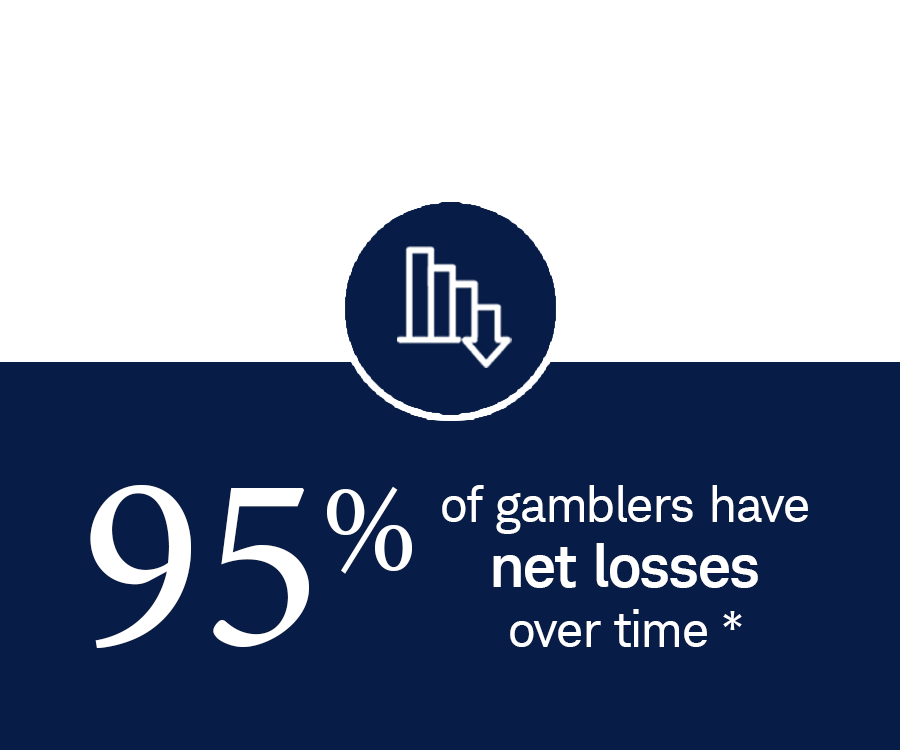
This is not a minor cultural shift. Frankly, it is a financial literacy crisis in the making.  UC San Diego Rady School of Management studied more than 700,000 online gamblers over five years through 2023, tracking digital payment records across 32 states. The researchers found that fewer than 5% of online sports gamblers have withdrawn more money from their gambling apps than they deposited. Let's flip that sentence. More than 95% of participants are net losers over time. This is not a feature of bad luck or poor timing. It is the mathematical inevitability built into these products by design.

There's also a landmark 2024 working paper titled 'Gambling Away Stability: Sports Betting's Impact on Vulnerable Households.' And it provides some of the most rigorous evidence yet of what is actually happening to household finances as online betting has spread across America. Using transaction data for more than 60 million Americans and analyzing behavior in roughly 230,000 households, and this is from 2010 through September of 2023, and the researcher's findings are jarring. When online sports betting became available in a state, participation spread quickly, and it did not slow down. Users who were net losers did not gradually learn their lesson and step back. Instead, they bet more. The research found not only an expansion among new users, but a pattern in which losing participants increased their wagering over time, a dynamic consistent with the addictive behavioral profile these platforms are designed, consciously or not, to cultivate.

Now, critically, the increase in gambling spending came at the expense of savings and investment. For every dollar directed towards sports betting, net investment in equities and other financial instruments fell by just over $2. The money flowing into these gambling sites was not discretionary leisure spending. It was likely wealth that would otherwise have been building toward longer term financial security. Now, the platforms are frictionless by design. A bet can be placed in seconds from a phone at two in the morning, however, the financial consequences are anything but.

And younger people today continue to see very solid, hard economic data—that's the actual economic data when we say 'hard'—but they feel very little, if any, benefits. That has helped pave the way for more speculative efforts to build wealth, with the belief that it can happen faster compared to what are thought of as more traditional methods, like purchasing a house or investing in the stock market.

[High/low chart for "Younger speculators" for Percentage of respondents agreeing with the statement "I invest, or may invest, in high-risk or speculative investments because I feel financially behind" is displayed]

There was a recent Harris Poll survey that provides supporting evidence for this. As shown here, when asked if they agree with the statement, 'I invest or may invest in high risk or speculative investments because I feel financially behind,' 80% of Gen Z respondents said yes. That compares to 75% of Millennials, 66% of Gen Xers, and 51% of my generation, the Baby Boomers.

Unfortunately, with stocks incredibly volatile under the weight of the war in Iran, more speculative money betting methods might look even more enticing to those who are seeing their portfolios struggle with these ups and downs in the market.

The conflation of investing in gambling, of course, is not entirely new. Critics of financial markets have made the comparison for as long as markets have existed, but there is a meaningful difference between a cynical critique and a deliberate business model built around blurring the line. Prediction markets and sports betting platforms are increasingly marketing themselves to the same demographic that the financial services industry is trying to reach with a very different message, one about the importance of saving, compounding, and investing for the long term.

For those who understand what they are doing and can afford to lose what they wager, responsible gambling is a legitimate form of entertainment. There is nothing inherently wrong with placing a bet on a football game, just as there is nothing inherently wrong with buying a lottery ticket. The problem arises when that activity is dressed up to look like a wealth-building strategy, when the risks are obscured behind engaging interfaces, social reinforcement, and when a generation of potential long-term investors comes to believe that outcomes are random, regardless of what approach they take.

[List of "Takeaways" is displayed]

Investing is a discipline. It involves goals, time horizons, risk tolerance, and the willingness to stay the course, especially when volatility makes that difficult. It's not about excitement or entertainment, though markets certainly provide plenty of both uninvited, especially in a week like this. Research does make it clear that dollars diverted from equity and bond markets and savings vehicles into betting platforms are not being redeployed into equivalent forms of risk-taking. They are being consumed. The expected value is negative. The platform generally wins. And the true cost is not just the losing bet. Generally, it is the compounded future value of the investment that was never made.

Now, let me conclude with a bit of a Schwab commercial. At Schwab, we are in the outcomes business. Our purpose is to help investors build and protect wealth over time, not to make the pursuit of financial security feel like a night in Las Vegas. The best thing we can do for the next generation of investors, particularly given the noise they are navigating, is to be unflinching about that distinction. Owning beats hoping, discipline beats speculation, and the long run, as it always has, belongs to those who invest in it.

Thanks, as always, for tuning in.
Video Transcript

Owning vs. Hoping: The Difference Between Investing and Gambling

Hi, everyone. I'm Liz Ann Sonders, and this is the April Market Snapshot. Thank you, as always, for tuning in.

This month's episode is a little more big picture, and on a topic that will likely remain evergreen, but it does have a tie-in to the current crazy market environment. In fact, I published a report on the subject this week as well, but I wanted a video version of it, so here we go.

There is a concept that has long anchored the philosophy of long-term wealth creation, which is owning. When you invest, you are generally acquiring a claim on future cash flows and on productive assets, on the compounding engine of capitalism itself. You are not wagering on an outcome and walking away with either a windfall or nothing. You are a participant in the ongoing enterprise of wealth creation, and that distinction matters more than it may seem at first glance, especially in today's environment.

Now, gambling operates on an entirely different logic. The gambler hopes. The investor owns. Both involve uncertain outcomes and both require accepting the possibility of loss, but the underlying architecture of each is fundamentally different. A diversified portfolio held through cycles and volatility historically has rewarded patience and discipline with real compounding returns. Although of course, past performance is no guarantee of future results. The house in casino gambling, a sports book or a prediction market is structured to help ensure that in the aggregate it wins and the participants in the aggregate do not.

This distinction has never been more important to articulate clearly. The youngest generation of investors is being inundated with the message that investing and gambling are essentially the same thing. The platforms and often the personalities delivering that message have worked hard to make the experience look and feel like a casino—emphasizing entertainment, instant gratification, the thrill of placing a bet on nearly anything these days.

[High/low charts for "Betting goes bonkers" for Prediction market monthly notional volume, number of transactions and number of users is displayed]

Prediction markets specifically have grown exponentially, as shown here. It's not just monthly volume growth, which has risen to more than $25 billion since 2024, and that's according to Dune. It's also total transactions which have skyrocketed from about 240,000 to more than 200 million, while monthly active users have grown from about 4,000 to almost 900,000. At the same time, a March 2026 report from Citizens JMP Securities covering the period from just last July, July 2025, to mid-March 2026, showed that prediction market users experienced higher losses than users of other gambling products, with a median loss of 8% compared to a loss of 5% for sports betters.

And the language often used to advertise these platforms is admittedly seductive. However, nearly absent from this messaging is any serious acknowledgement of the financial risks involved or any honest reckoning with what the data actually show about outcomes.

This is not a minor cultural shift. Frankly, it is a financial literacy crisis in the making.  UC San Diego Rady School of Management studied more than 700,000 online gamblers over five years through 2023, tracking digital payment records across 32 states. The researchers found that fewer than 5% of online sports gamblers have withdrawn more money from their gambling apps than they deposited. Let's flip that sentence. More than 95% of participants are net losers over time. This is not a feature of bad luck or poor timing. It is the mathematical inevitability built into these products by design.

There's also a landmark 2024 working paper titled 'Gambling Away Stability: Sports Betting's Impact on Vulnerable Households.' And it provides some of the most rigorous evidence yet of what is actually happening to household finances as online betting has spread across America. Using transaction data for more than 60 million Americans and analyzing behavior in roughly 230,000 households, and this is from 2010 through September of 2023, and the researcher's findings are jarring. When online sports betting became available in a state, participation spread quickly, and it did not slow down. Users who were net losers did not gradually learn their lesson and step back. Instead, they bet more. The research found not only an expansion among new users, but a pattern in which losing participants increased their wagering over time, a dynamic consistent with the addictive behavioral profile these platforms are designed, consciously or not, to cultivate.

Now, critically, the increase in gambling spending came at the expense of savings and investment. For every dollar directed towards sports betting, net investment in equities and other financial instruments fell by just over $2. The money flowing into these gambling sites was not discretionary leisure spending. It was likely wealth that would otherwise have been building toward longer term financial security. Now, the platforms are frictionless by design. A bet can be placed in seconds from a phone at two in the morning, however, the financial consequences are anything but.

And younger people today continue to see very solid, hard economic data—that's the actual economic data when we say 'hard'—but they feel very little, if any, benefits. That has helped pave the way for more speculative efforts to build wealth, with the belief that it can happen faster compared to what are thought of as more traditional methods, like purchasing a house or investing in the stock market.

[High/low chart for "Younger speculators" for Percentage of respondents agreeing with the statement "I invest, or may invest, in high-risk or speculative investments because I feel financially behind" is displayed]

There was a recent Harris Poll survey that provides supporting evidence for this. As shown here, when asked if they agree with the statement, 'I invest or may invest in high risk or speculative investments because I feel financially behind,' 80% of Gen Z respondents said yes. That compares to 75% of Millennials, 66% of Gen Xers, and 51% of my generation, the Baby Boomers.

Unfortunately, with stocks incredibly volatile under the weight of the war in Iran, more speculative money betting methods might look even more enticing to those who are seeing their portfolios struggle with these ups and downs in the market.

The conflation of investing in gambling, of course, is not entirely new. Critics of financial markets have made the comparison for as long as markets have existed, but there is a meaningful difference between a cynical critique and a deliberate business model built around blurring the line. Prediction markets and sports betting platforms are increasingly marketing themselves to the same demographic that the financial services industry is trying to reach with a very different message, one about the importance of saving, compounding, and investing for the long term.

For those who understand what they are doing and can afford to lose what they wager, responsible gambling is a legitimate form of entertainment. There is nothing inherently wrong with placing a bet on a football game, just as there is nothing inherently wrong with buying a lottery ticket. The problem arises when that activity is dressed up to look like a wealth-building strategy, when the risks are obscured behind engaging interfaces, social reinforcement, and when a generation of potential long-term investors comes to believe that outcomes are random, regardless of what approach they take.

[List of "Takeaways" is displayed]

Investing is a discipline. It involves goals, time horizons, risk tolerance, and the willingness to stay the course, especially when volatility makes that difficult. It's not about excitement or entertainment, though markets certainly provide plenty of both uninvited, especially in a week like this. Research does make it clear that dollars diverted from equity and bond markets and savings vehicles into betting platforms are not being redeployed into equivalent forms of risk-taking. They are being consumed. The expected value is negative. The platform generally wins. And the true cost is not just the losing bet. Generally, it is the compounded future value of the investment that was never made.

Now, let me conclude with a bit of a Schwab commercial. At Schwab, we are in the outcomes business. Our purpose is to help investors build and protect wealth over time, not to make the pursuit of financial security feel like a night in Las Vegas. The best thing we can do for the next generation of investors, particularly given the noise they are navigating, is to be unflinching about that distinction. Owning beats hoping, discipline beats speculation, and the long run, as it always has, belongs to those who invest in it.

Thanks, as always, for tuning in.
The line may be blurring, but the outcomes are not.

Some in our industry make betting and investing feel interchangeable. When investing is framed like a game, it obscures a fundamental truth: One is designed to help investors grow wealth over time. The other is entertainment.

Both involve risk, but history shows that long-term investors are more likely to have positive outcomes over time. Gambling is different—over time, outcomes are more often negative, regardless of short-term wins or streaks.

What we want you to know about it.

Gambling can be a form of entertainment for people who understand the risks. The issue is confusion, which can lead to financial decisions with lasting consequences.

At Schwab, we treat that confusion as a financial literacy opportunity. Every day, we teach investors our core principles: diversification, discipline through market cycles, and staying focused on long-term goals.

And we invest in education beyond our clients. We support national nonprofits to advance financial literacy, create resources for teens and young adults, and conduct research aimed at improving how people make financial decisions.

We do this not to tell people what to do, but to help them understand the difference. Because when investors have that clarity, they're better equipped to make choices that support their long-term financial well-being.

Long-term investing vs. gambling.

Strategy

Investing: Slow and steady. Investors want to make a consistent return on their investments over time.

Gambling: Fast money. Gamblers are focused on a single event.

Risk

Investing: You determine your risk. You invest according to your goals and timelines: conservative, moderate, aggressive.

Gambling: Riskier. Circumstances outside of your control typically determine the odds.

Taxes

Investing: There are tax-advantaged investment options and accounts.

Gambling: You have to pay taxes on any gambling or lottery winnings over $600.

The power of long-term investing.

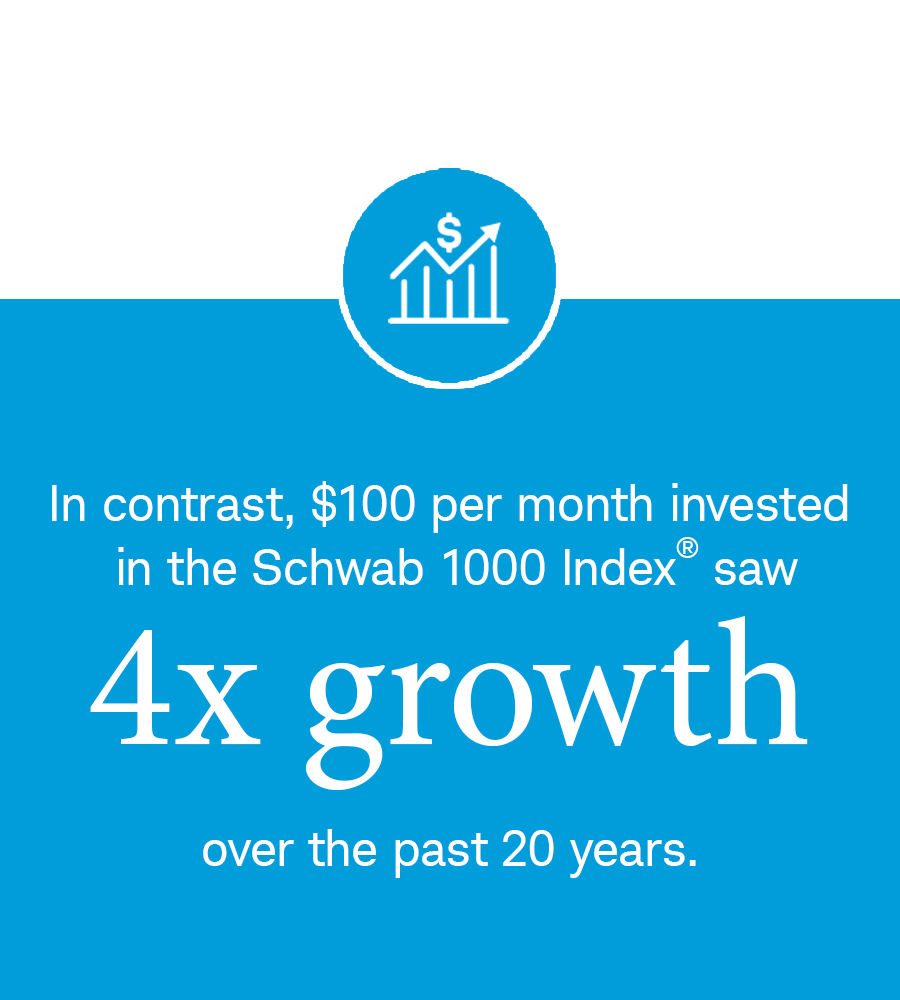
Over time, gambling usually has a negative expected return.* In contrast, if we look at long-term investing, there's more potential for growth. For example, a $100-per-month investment in the Schwab 1000 Index saw a 4x return on the original investment over the past 20 years.

Loading…

Explore the resources.

We've gathered articles, podcasts, and educational tools that take a deeper look at the difference between investing and gambling—and how you, and the young investors in your life, can build healthier financial habits over time.

Gambler's Blues: Betting Isn't Investing

Sports Betting vs. Investing: 4 Key Differences

Schwab 7 Investing Principles

On Investing®: Empowering the Next Generation Through Financial Education